The Department of Landscape Architecture and Regional Planning at UMass Amherst providesSustainable Solutions to Complex Problems. We educate outstanding students, serve diverse communities, and undertake influential scholarship. We seek to exemplify a new generation of professionals and educators who work collaboratively across disciplines and cultures. This provides leadership to find regenerative, equitable and beautiful designs, spatial and social practices.
Here are some great tips about how to build a Federal Resume from The Partnership for Public Service. If you follow these directions, you will be sure to put your best foot forward when applying for jobs on USAjobs.gov!
:is(.wp-block-embed__wrapper, …
By Rebecca Bell
Rebecca BellAssociate Director of Career and Professional Development for SBS
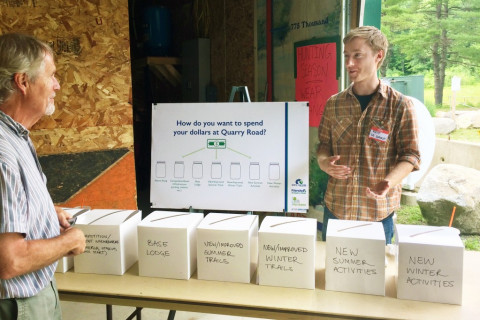
This summer, Reif Larsen ’18 (landscape architecture) interned in the Burlington, VT offices of SE Group, a landscape architecture and planning firm that works on a range of projects, specializing in recreation planning and design for …
“Whenever I get a stack of resumes, I throw half of them in the trash. I sure don’t want unlucky people on my team,” said no hiring manager ever…but sometimes it can feel that way when you’re hunting for jobs.
Sign up to WayUp to personalize your job search and apply to opportunities from Fortune 500s to startups, all in one place. Let's get you hired! Click here
SBS RISE is designed to create community, and provide specialized academic programs and opportunities for underrepresented students within SBS (those …
The SBS Office of Career & Professional Development annually surveys graduating seniors in order to provide a snapshot of their post-graduation plans. The survey begins just prior to graduation, and continues until six months after graduation. Our data collection process is guided by the industry standard put forth by the National Association of Colleges & Employers, and includes information collected by the SBS Office of Career & Professional Development, the Office of Institutional Research at UMass Amherst, and by various academic departments, as well as from information that is made publicly available by students. The SBS undergraduate outcomes knowledge rate for 2022 was 70%, though knowledge rate varies among departments.
The SBS Office of Career & Professional Development annually surveys graduating seniors in order to provide a snapshot of their post-graduation plans. The survey begins just prior to graduation, and continues until six months after graduation. Our data collection process is guided by the industry standard put forth by the National Association of Colleges & Employers, and includes information collected by the SBS Office of Career & Professional Development, the Office of Institutional Research at UMass Amherst, and by various academic departments, as well as from information that is made publicly available by students. The SBS undergraduate outcomes knowledge rate for 2022 was 70%, though knowledge rate varies among departments.
First Destination
Top Employers
Starting Salary
Job Titles
Employment Locations
Top Universities
Degree Types
Fields of Study
First Destination
SBS graduates pursue a range of plans after graduation, including employment, continuing education, and volunteering/service, among others. This graph depicts what recent SBS graduates tell us they are doing within six months after graduation.
Top Employers
Students in the College of Social & Behavioral Sciences at UMass Amherst build the skills employers seek, such as critical and analytical thinking, creative problem solving, communication, cultural awareness, and more. This makes our students highly attractive candidates for a wide variety of roles with an even wider range of employers and industries. The list of employers featured here is based on information reported by students or employers to SBS, or employment data that is made publicly available by students. The list is formulated based on the most-commonly reported hiring employers. Generally, the first ten on the list have hired multiple students, and after that, employers who have hired at least one SBS grad are listed in alphabetical order. Survey data indicated that a minimum of 330+ distinct employers hired UMass students in 2022.
Starting Salary
Starting salary data is self-reported by the new graduates and is not a required field on the survey, so this data is incomplete with regard to salary ranges. Keep in mind that salaries for volunteer/service roles are, by their nature, low, and skew the averages lower. There are also students making significantly more than the average. Both cost of living (based on geographic location), and chosen industry have a significant impact on starting salaries. These data do not include information on benefits such as health insurance, tuition reimbursement, bonuses, and other important factors in a student's employment decision making process.
Job Titles
Employment Locations
A majority of students in the College of Social & Behavioral Sciences, as with the University as a whole, are residents of Massachusetts. While the majority of our graduates choose to stay in Massachusetts for their first post-graduate jobs, many others accept positions all across the country, and around the world. Common first destination locations are Washington, D.C., New York City, California, and the other New England states.
United States
World
Top Universities
The list below provides a look at the most-commonly reported graduate schools in which SBS graduates are enrolled. While many SBS graduates choose to stay at UMass Amherst for their graduate education, many others attend universities across the country and around the world.
Degree Types
Fields of Study
The variety of fields of study selected by SBS graduates is a good indication of their diverse interests, and their desire to both expand and deepen their understanding of their area of interest.
We don’t have enough student data to show you these results.




 Patricia McGirr